Steal Our Customer Journey: A 6-Stage Map From First Click to Fanatic Fans

Stephanie Duenas

Staff at Benamor Galvez
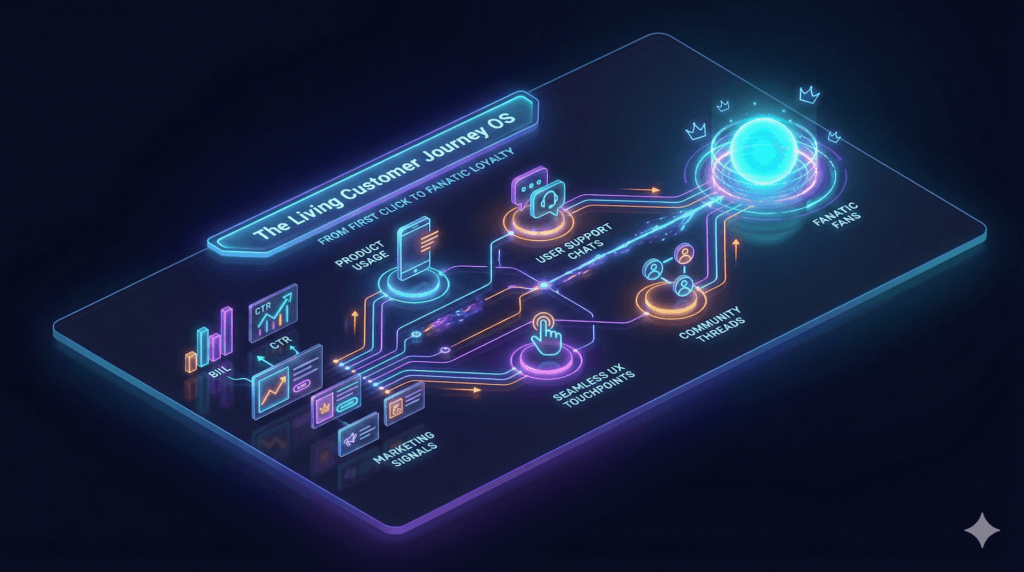
Then something predictable happens: the campaign ends, the team moves on, and the “customer experience” becomes a separate universe handled by different people, with different goals, and different dashboards.

That gap is expensive.

A customer journey map fixes it—when it’s built like an operating system, not a pretty slide.

What you’re about to read is the exact customer journey framework we use at Benamor Galvez to align messaging, content, sales enablement, delivery, and retention into one coherent path. You can steal it, adapt it, and use it to pressure-test your own marketing and customer experience—whether you’re B2B, B2C, ecommerce, services, or a hybrid.

What a customer journey map actually does (beyond the buzzword)

A solid journey map is not a funnel diagram with nicer labels.

It is a decision-making tool that helps you:

  • Understand intent at each stage (what the customer is trying to solve, fear, or confirm)

  • Align internal teams (marketing, sales, success, product, ops) around the same outcomes

  • Choose the right tactics (not “more content,” but the right content for the moment)

  • Define measurable proof (KPIs that match what the customer needs to see next)

  • Build loyalty on purpose (instead of hoping retention “just happens”)

In short: it turns customer behavior into a roadmap your brand can execute.

The 6 stages we use (and why we added two most brands ignore)

  1. Most journeys stop at purchase. That’s where the real leverage begins.

    Here’s our 6-stage model:

    1. Discovery – They first notice you and learn you can move them from pain to gain.
    2. Consider – They vet you: “Can you actually deliver?”
    3. Transact – They commit: “Are you the right partner to trust?”
    4. Experience – The truth moment: you either meet expectations—or you don’t.
    5. Loyalty – They expand: “This works. Let’s do more.”
    6. Fanatic – They advocate publicly: “You’re our secret weapon.”

    Stages 4–6 are where most brands lose margin or miss growth. We treat them as first-class marketing stages because they are.

    Below is the full framework—mindset, goals, tactics, and KPIs—stage by stage.

Stage 1: Discovery

What’s happening

The customer discovers you for the first time and senses that you can get them from pain to gain.

Customer mindset

“I need an agency that understands both our brand and our business goals.”

Goal

Build awareness among B2B and B2C brand leaders, especially CMOs.

Marketing tactics (what works here)

  • Thought leadership on LinkedIn targeting CMOs (content aligned with data, brand positioning, ROI)
  • Google Search Ads (e.g., “Top advertising agencies in Miami,” “B2B brand strategy partners”)
  • High-impact video content and case study snippets on social and YouTube
  • Industry event appearances (local and national), tradeshows, speaking engagements
  • PR, podcasts, awards
  • Awareness campaigns that clarify positioning (full-service, data-smart creative rooted in strategy and cultural relevance)

    Key KPIs (what to measure)

  • Impressions
  • New website visitors
  • CTR
  • Event engagement
  • Brand recall

The insight brands miss in Discovery

Discovery is not about telling your whole story. It’s about making one promise feel credible enough to earn the next step.

If your Discovery content tries to explain everything, it usually explains nothing.

Stage 2: Consider

What’s happening

Now they’re evaluating you. They’re asking: can you deliver on their transformation?

Customer mindset

“Can Benamor Galvez actually deliver measurable results for our brand?”

Goals

Demonstrate:

  • strategic credibility
  • analytical depth
  • creative strength

Marketing tactics

  • Downloadable case studies tied to industry-specific outcomes
  • Video explainers on process and how services integrate (creative + media + data)
  • CMO-specific nurture emails with proof of ROI, trends, and thought leadership
  • Segmented landing pages by business type (B2B, B2C, retail, tech, etc.)
  • 1:1 personalized email outreach from leadership

Key KPIs

  • Time on site
  • Asset downloads
  • Email open rate
  • Meeting requests

The insight brands miss in Consider

Consideration is a trust-building stage, not a persuasion stage.

The customer is looking for signals like:

  • “They understand my world”
  • “They’ve done this before”
  • “They can measure success”
  • “They can explain how they work”

If your content doesn’t reduce perceived risk, it won’t convert.

Stage 3: Transact

What’s happening

They’re ready to make a commitment. This is where hesitation is expensive—because it’s rarely about price. It’s about uncertainty.

Customer mindset

“Is this the right agency to trust with our budget and KPIs?”

Goals

Convert interest into:

  • formal proposals
  • SOW discussions
  • signed commitments

Marketing tactics

  • Strategic audit offering for inbound prospects
  • Proposal templates focused on outcomes and clear metrics (e.g., CAC, LTV, conversion rate)
  • Leadership-led pitch presentations tied to the client’s business vision and cultural relevance
  • Referral outreach from existing clients
  • CRM retargeting to unconverted MQLs with tailored insights

Key KPIs

  • Conversion rate
  • Cart recovery rate (or “return-to-proposal” rate in services)
  • Online order volume / signed SOW volume
  • In-store purchases (or closed-won revenue for services)

The insight brands miss in Transact

The customer isn’t just buying the deliverable.

They’re buying:

  • Your communication habits
  • Your reporting discipline
  • Your ability to prioritize
  • Your ability to prevent surprises

If you can’t “sell the working relationship,” you’ll lose to someone who can.

Stage 4: Experience

What’s happening

This is the most emotionally loaded stage. The customer is in a heightened state of anticipation and is judging whether you live up to expectations.

Customer mindset

“How will they deliver and communicate performance?”

Goals

Deliver:

  • excellence

  • transparency

  • fast wins post-onboarding

Marketing tactics (yes—this is marketing too)

  • Onboarding playbook + client dashboard walkthrough

  • Monthly strategy and creative performance reviews

  • Executive reporting tailored to both CMO and CFO lenses

  • Cross-functional access (data, strategy, media, creative) from day one

Key KPIs

  • Client satisfaction score

  • Onboarding completion

  • Time-to-first-result

  • Retention rate

The insight brands miss in Experience

If the customer’s first 30–60 days feel confusing, slow, or inconsistent, you will spend the next 6 months trying to “win back trust” you should never have lost.

Experience is where churn is prevented—or created.

Stage 5: Loyalty

What’s happening

They’ve seen enough success to want more. This is where relationships become accounts.

Customer mindset

“This team gets it—let’s expand the relationship.”

Goals

Build long-term partnerships and increase client value.

Marketing tactics

  • Quarterly business reviews with proactive growth recommendations
  • Pilot programs / A/B tests to explore new services
  • Executive briefings on key industry shifts
  • Loyalty incentives for multi-service engagements
  • Integration with the client’s marketing stack/tools

Key KPIs

  • Contract renewals
  • Cross-sell rate
  • CLV (customer lifetime value)
  • Referral likelihood

The insight brands miss in Loyalty

Loyalty is rarely earned through “checking in.”

It’s earned through:

  • proactive ideas
  • clear performance narratives
  • strategic expansion that feels obvious (not salesy)

Stage 6: Fanatic

What’s happening

This is advocacy—public, credible, reputation-building advocacy.

Customer mindset

“Benamor Galvez is our secret weapon—they’ve earned a shout-out.”

Goals

Inspire advocacy and elevate brand reputation.

Marketing tactics

    • Client success stories + co-branded case studies published and promoted
    • Invite clients to speak on webinars, podcasts, events
    • Strategic referral program for enterprise accounts
    • Social proof systems (LinkedIn recommendations, endorsements)
    • Earned media pitches featuring client/agency partnerships

Key KPIs

  • Public testimonials
  • Referrals
  • Earned media mentions
  • Share of voice

The insight brands miss in Fanatic

Advocacy is not a “nice-to-have.” It is a distribution channel.

If you systematize advocacy, you reduce CAC, increase close rates, and build brand credibility faster than paid media alone can.
Build your own customer journey

Want to apply this framework to your own brand?
Download the same worksheet we use at BNMR GLVZ to map your full customer journey from click to fan.

Carolina Gonzalez

Creative Director at Benamor Galvez

Related Article

Build Your Own Customer Journey

Enter your email to access the worksheet.

"(Required)" indicates required fields

Name(Required)